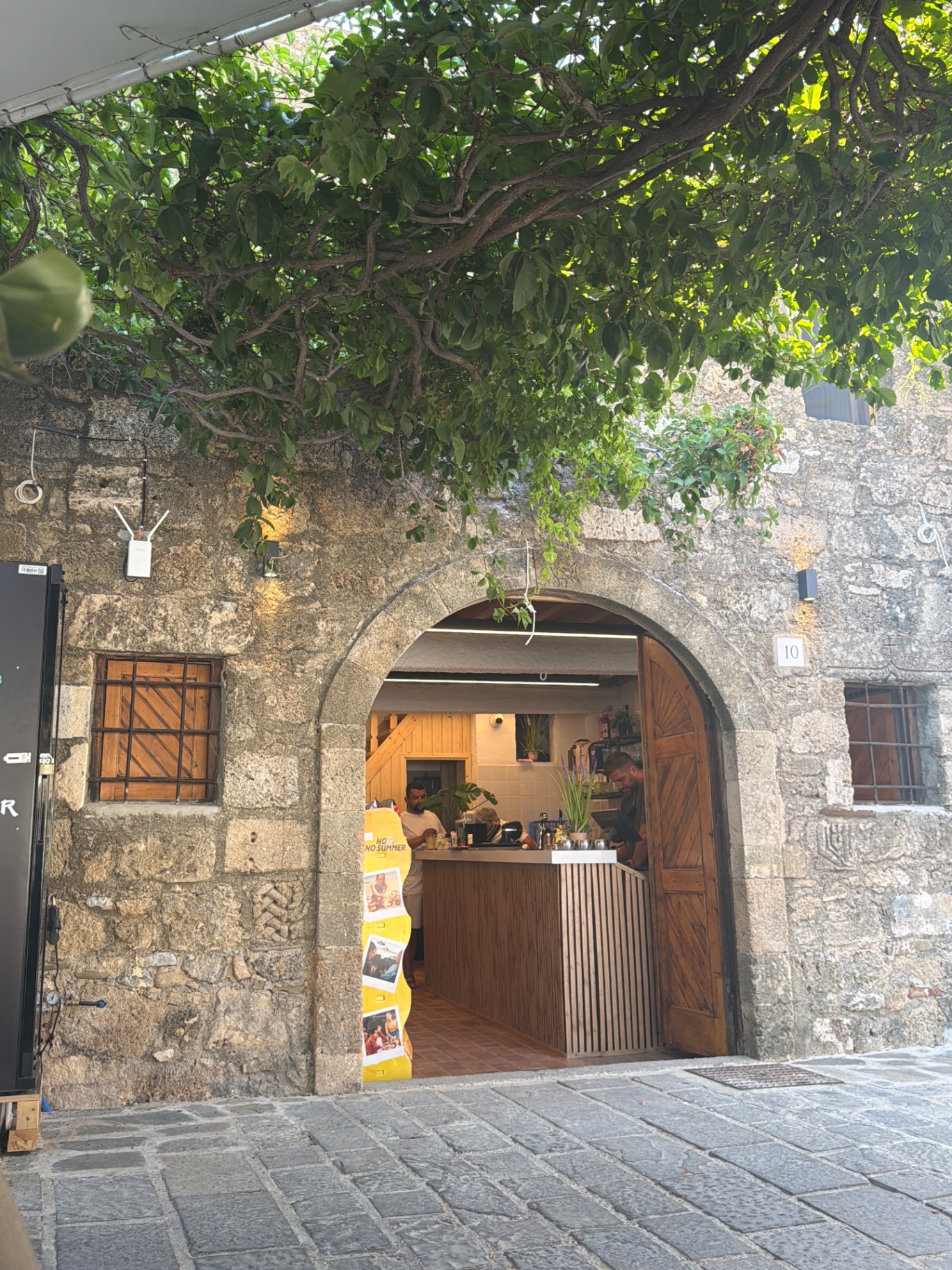
The Boathouse
Long before Pallas Beach became a place for sunbeds and swimming, this part of Lindos was simply known as the Skala — the village's small harbour and gateway to the sea.
Between the sea, the village and the Acropolis.
The Boathouse stands on one of the most logical spots in Lindos: exactly between the sea, the village and the Acropolis.
Pallas Beach has always been a beach — but for centuries it was also Lindos's gateway to the sea. This was where boats came in, where goods were brought ashore, and where the path up to the village began.
The building sits on precisely that point. The wide arched door opens toward the water. The thick stone walls keep the interior cool. The small barred windows protected what was kept inside. Along the road beside the building, boats, gear and goods could be moved up into Lindos.
Above it all watches the Acropolis. From there, Lindos looked out for centuries over the bay, the ships and the approach to the village.
This is why The Boathouse stands here: on the spot where the sea, trade, protection and daily life came together. It was never incidental beachfront architecture — it was part of the old connection between Lindos and the sea.
A history drawn from the stories as told, what we can observe in the stone, and what has been passed down.
How it may once have looked
A visualisation, not a historical document. The façade, the arched entrance, the small barred windows and the carved stones are drawn from the building as it still stands today.
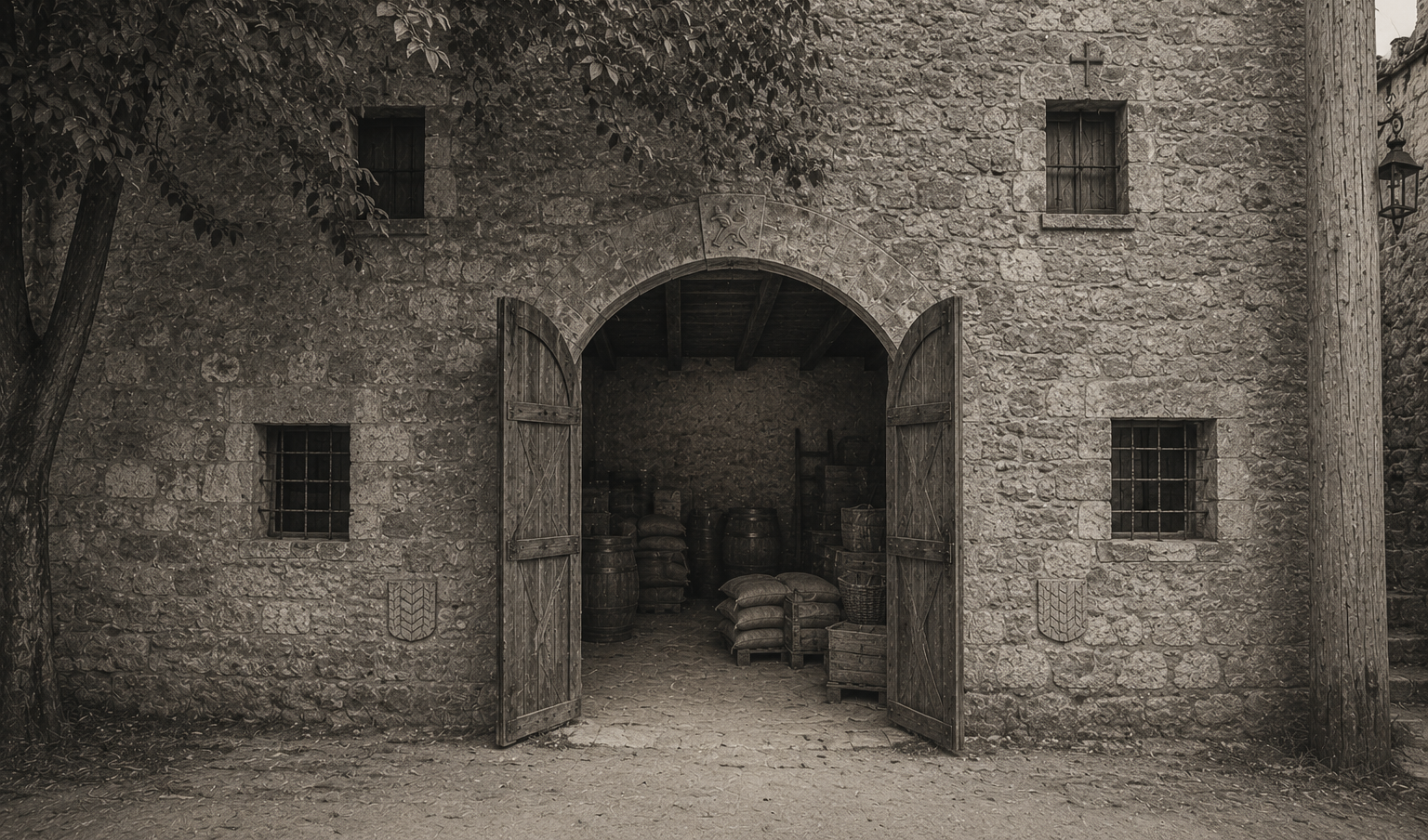
An imagined view of the building in its Skala days: the wide arched doors thrown open, small barred windows in exactly the positions still visible today, boats and gear kept just inside, and the mulberry tree overhanging the roof. Based on the façade as it still stands.
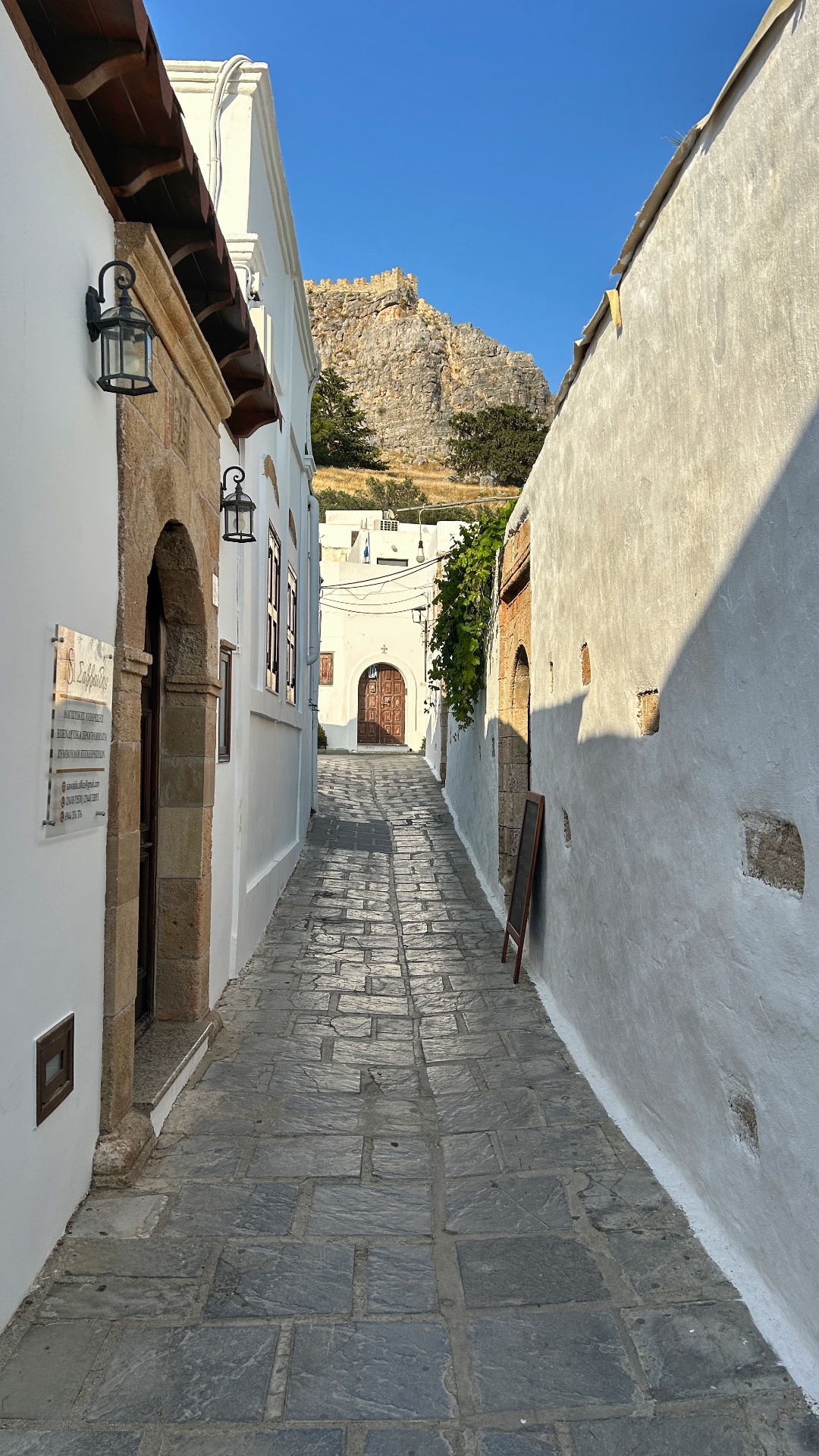
The village above the beach
Whitewashed lanes running down to the sea, a medieval acropolis watching over the bay — Lindos is where this story belongs.
The same light, the same stones, the same sea — for centuries.
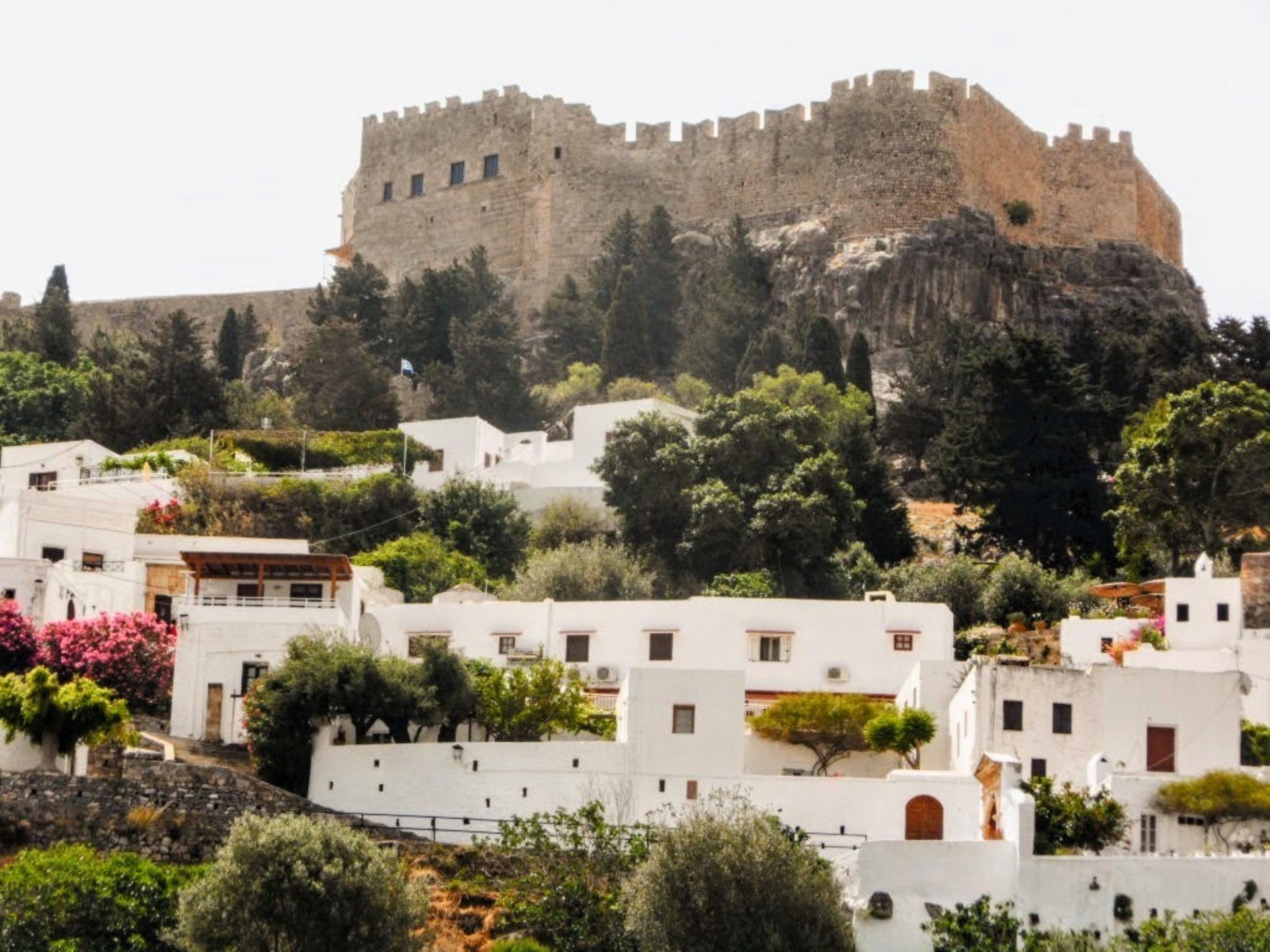

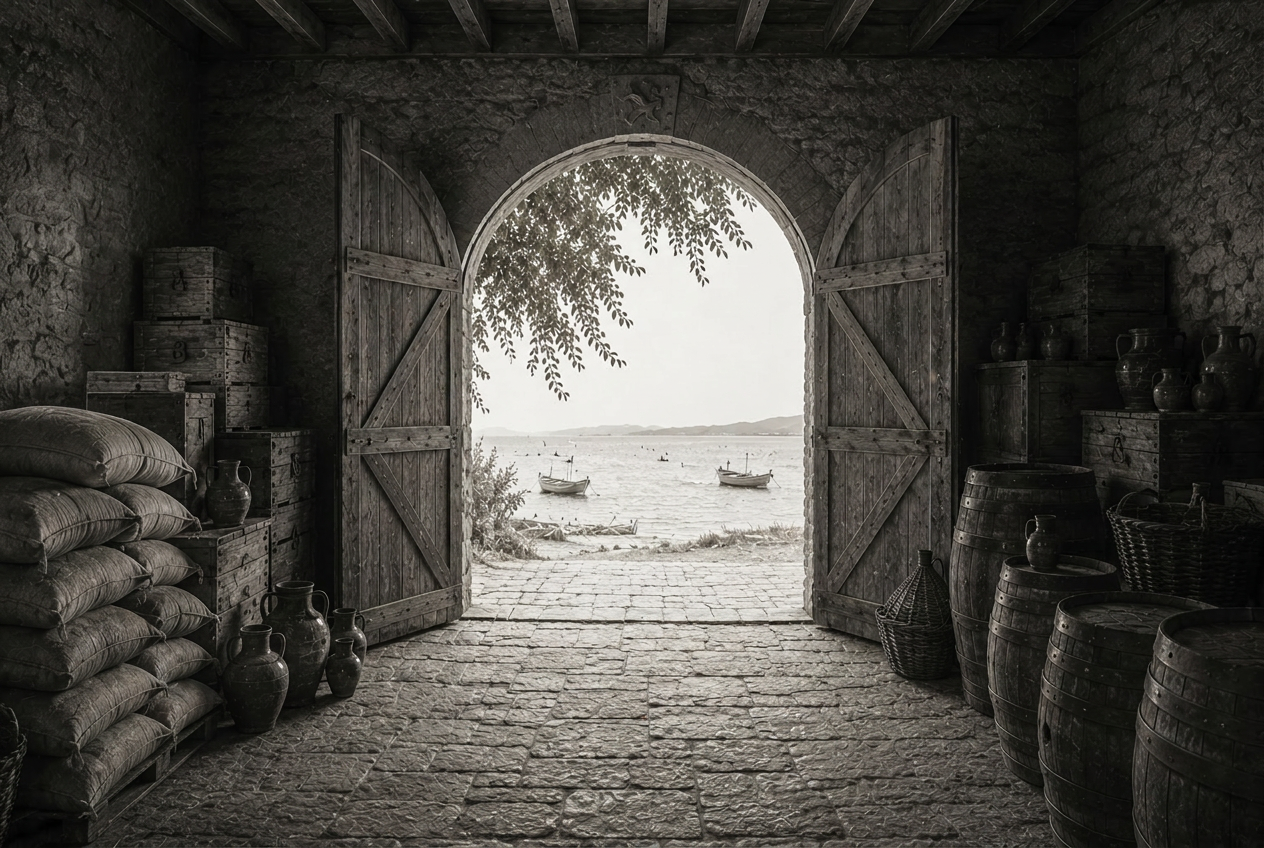
Boats, nets, gear, storage — that is what this building was for, as long as anyone can remember. Today the tables stand set beneath the awning, and the doors that once opened for boats open every morning for guests.
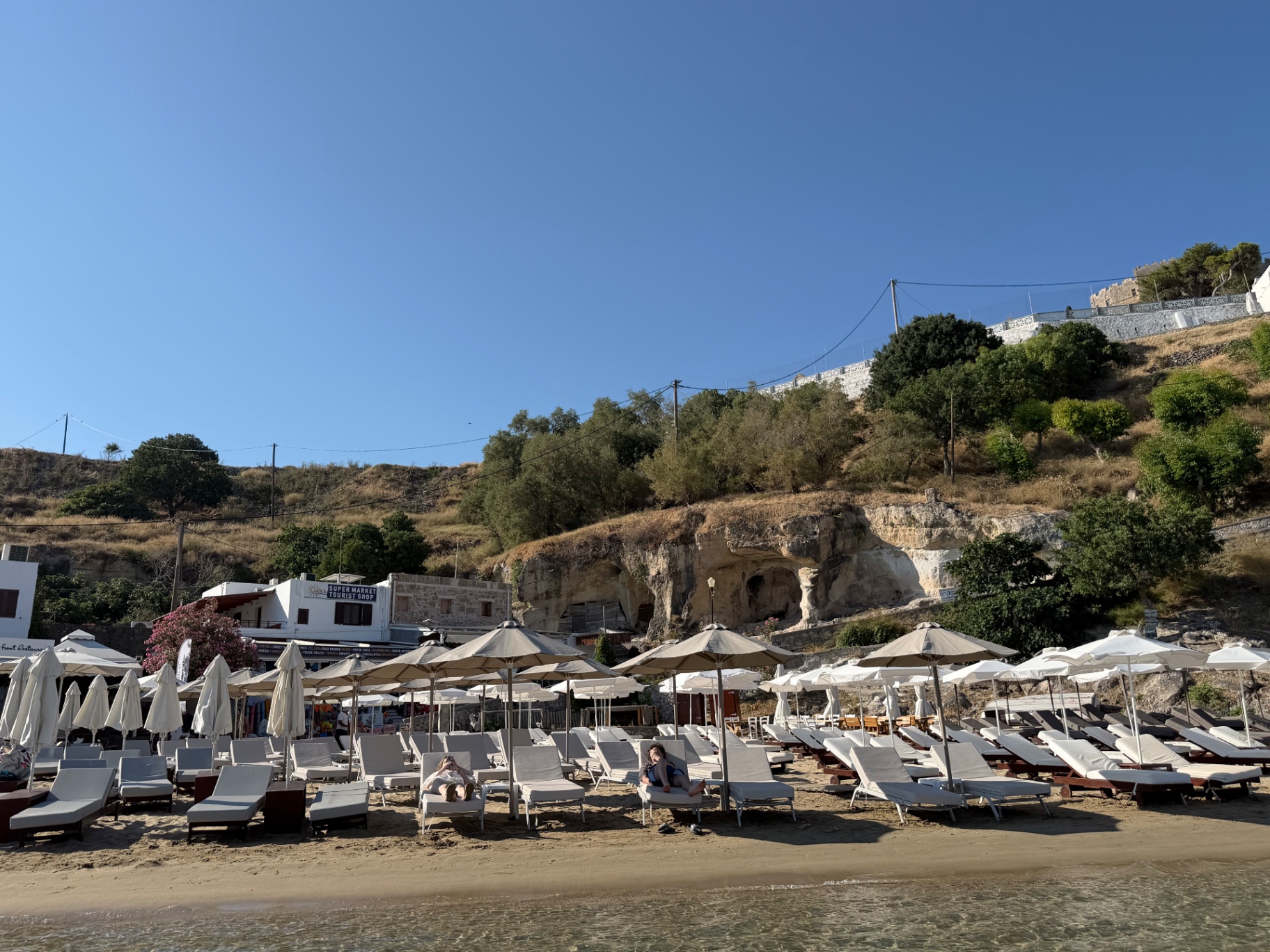
Beneath the acropolis, at the edge of the bay — where the Boathouse has waited for centuries.
The building still carries its own history in stone.
A bird carved into the keystone above the entrance, a small cross above the window, and two finely worked stones flanking the door — clearly older than the rough limestone around them — anchor the building to the Byzantine and medieval layers of Rhodes. Together they mark this as a building of the old Skala, not a later addition to the beach.
The symbols were also a message aimed outward, toward the sea. To a sailor stepping onto the sand or a merchant looking up from the beach, the bird and the cross above the door were immediately readable: this is a safe place, watched over — you may come ashore in peace. In a busy Skala full of strangers, that quiet reassurance mattered as much as the walls themselves.
Read what the symbols meanWhere history ends, hospitality begins.
In old Lindos, the symbols on this façade carried three meanings at once. They were meant to protect the building, its people and the goods inside from harm. They stood for a quiet protection of the soul — a reminder that a watchful presence looked after everyone who stepped through the door. And they were a message to anyone passing by: this is a place of trust, faith and hospitality — a safe shore to come ashore, to trade, to find shelter.
The same values that were carved into these stones centuries ago — protection, care for the soul, and trust for every passer-by — still shape Lindos Boathouse today. Everyone is welcome here to rest for a while and feel at home.
Come once, and the stones have already watched over you.
From the Skala to today
Two and a half thousand years of Lindos, told through one small building on the shore.
- AntiquityThe Acropolis above, the sea below
Lindos was already a major town in ancient Greece, watched over by its Acropolis on the cliff. The small bay below served as its natural harbour long before any of the buildings still standing today existed.
- Lindos is one of the oldest continuously inhabited towns on Rhodes.
- Pallas Beach was already the town's natural landing point on the sand.
- No building yet — but the shape of the shoreline is already set.
- Byzantine period · c. 600 – 1300A Christian island at the crossroads
Under Byzantine rule, Rhodes became a deeply Christian island at the meeting point of Europe, Asia and the Middle East. Churches, homes and warehouses were routinely marked with protective symbols — the tradition from which the bird and the cross on this façade almost certainly come.
- Protective symbols carved into stone became standard across the island.
- The tradition that would later mark this façade is born in this period.
- Some of the finely carved stones in the wall may already have existed as parts of Byzantine buildings elsewhere on Rhodes.
- 1309 – 1522The Knights of Saint John
For more than two centuries, Rhodes was ruled by the Knights of Saint John. They rebuilt harbours and fortified villages across the island. Many of the older stones in this façade were most likely reused during this period — cut for earlier buildings, then set again into new walls.
- The Knights rebuild harbours, walls and warehouses across Rhodes.
- Older Byzantine stones are routinely reused as spolia in new construction.
- Possibly the period in which this building — or its core — was raised on the Skala, though no dated document confirms it.
- Late Middle AgesThe Skala of Lindos
For centuries this beach was also known as the Skala — the small landing where the boats of Lindos came ashore. According to local tradition, this stone building was the first structure ever raised on the sand: a summer place at the water's edge, most likely used by fishermen and merchants arriving by boat.
- According to local tradition, the very first building on the sand.
- Built directly opposite the small jetty of the old landing.
- Thick walls, iron-barred windows and a wide arched door — built to keep boats, gear and goods safe.
- Medieval Skala · the façade takes shapeThe Stones of the Boathouse
At some point during the Skala years, the façade is finished the way we still see it today: a bird carved into the keystone above the door, a small cross above the window, and older worked stones set on either side of the entrance. To the people of Lindos these were not decoration — they were a quiet protection meant for the people. Not for the walls, not for the goods inside, but for everyone crossing the threshold, and above all for those arriving from the sea. For a sailor stepping off a boat onto the sand, the symbols above the door were an immediately readable message: this is a safe place, watched over — you may come ashore in peace.
- The bird, the cross and the reused stones are set into the façade as protective symbols.
- The building becomes a visible marker of a safe landing on the Skala of Lindos.
- The origin of what we now call the Stones of the Boathouse — a welcome carved in stone for every visitor who steps inside.
- 1522 – 1912Under Ottoman rule
After the Knights left, Rhodes passed to the Ottoman Empire for nearly four centuries. Life at the Skala went on much as before — small boats, fishermen, goods coming ashore and being carried up into the village.
- Rhodes becomes part of the Ottoman Empire for almost 400 years.
- Life at the Skala continues largely unchanged: fishing, small trade, daily arrivals by sea.
- The building remains a fixed presence on the sand at the water's edge.
- 20th centuryA working boathouse
In more recent decades, the building served as an actual boathouse — a place where local fishermen kept boats, nets and equipment safe from the sea. It is this chapter, still within living memory in Lindos, that gave the building the name it carries today.
- Used by local fishermen to shelter boats, nets and gear from winter storms.
- The wide arched door — always opening onto the sand — proved perfect for hauling boats inside.
- The chapter still remembered in Lindos today, and the reason the building is now called the Boathouse.
- Summer 2026For the first time, a restaurant
For the very first time in its known history, the building is no longer used for boats, gear or storage — it is a restaurant. The old Skala is now a beach for visitors, and the doors that once opened for boats now open for guests arriving by the sea.
- The first time in its known history that the building is open to the public every day.
- Nothing has been added to the façade — the bird, the cross and the carved stones are exactly where they have always been.
- The same wide door that once welcomed boats now welcomes guests from around the world.
Why "Boathouse"?
The name comes from the building's most recent chapter. For several decades in the twentieth century, this was a working boathouse — the place where local fishermen kept their boats, nets and equipment safe from the sea.
That memory is still alive in Lindos today. When the building reopened as a restaurant — for the very first time in its long history — we chose to keep the name it had earned in living memory, rather than invent a new one.
A place on the sand, then a boathouse, and now — for the first time — a restaurant. Every generation has given this building a new purpose without ever taking away its story.
The story of this building is still being written.
Future archival material and research will be added here.
Future archival material and research will be added here.
Future archival material and research will be added here.
Told the way Lindos tells it.
Some of this story is written in the stones themselves — the bird above the door, the cross above the window, the carved fragments set into the walls. The rest has been carried down through Lindos the way old villages carry things: from a grandfather at a table, from a fisherman mending nets, from someone pointing at a carving and saying, "that one was put there for a reason."
What you read here is the story as this shore has always told it.